Zekun Zhao

Ph.D. student, Computer Science and Engineering

University of California, Santa Cruz

I work with Jeffrey Flanigan on making large language model inference faster and on verifying the reasoning of language models. Recently I built Parallel Prompting, which answers many questions about one long document 3.7–6.0× faster than stock SGLang.

Zekun Zhao

Research

My research is on model inference, with an emphasis on efficiency and effectiveness: serving engines and attention kernels that make LLMs faster on real workloads, and methods that check whether a model's reasoning actually holds.

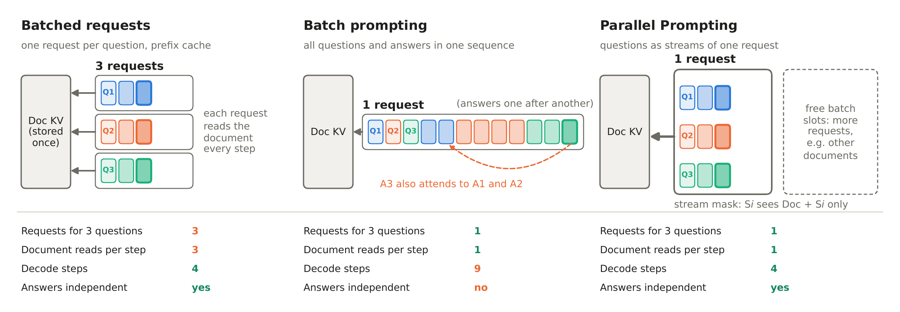
Batched requests, batch prompting and Parallel Prompting at one decode step
New · 2026

Read Once, Answer Many: Parallel Prompting for Shared-Context LLM Inference

Zekun Zhao, Jeffrey Flanigan · Preprint, 2026

Decodes many questions about one long document as parallel streams of a single request, so each decode step reads the document's KV cache once instead of once per question. Built into SGLang with an in-kernel stream mask, CUDA-graph decoding and continuous batching.

  • 3.7×faster than SGLang, A100
  • 5.9–6.0×faster, RTX A6000
  • 144 / 144paired runs faster
NeurIPS 2026 Workshop

Autoformalizing Chain of Thought: Representation, Verification, and Logical Shortcuts

Zekun Zhao, Zilong Li, Jon Cai, Federico Ortega-Riba, Martha Palmer, James Martin, Jeffrey Flanigan

Translates natural-language chain-of-thought into Lean 4 so that each reasoning step can be checked. A GRPO pipeline trains Qwen2.5-Coder with a reward that combines Lean 4 compiler checks with an LLM judge of faithfulness, with guards against reward hacking. An SFT warm-up raised the share of test statements that compile from 6% to 39% for a 0.5B model, and cached, parallel judge calls made each training step 3× faster.

News

Publications

Education

Teaching & Service

Earlier projects

Course projects and reports
  • Mimic Face: a real-time web application for 3D face animation. [Video]
  • How does our body feel? Human health data visualization. [Report] [Award]
  • Voting loss function: a voting mechanism to measure an estimate's smoothness and accuracy. [Report]
  • Gender obfuscation in text for privacy protection. [Report]
  • Multi-domain dialogue state tracking. [Report]
  • A survey on probabilistic programming in the context of neural networks. [Report]
  • Undergraduate and master's reports. [B.S. report] [M.S. report]